India’s luxury food and beverage industry has always been ambitious. Over the last decade, several global and homegrown premium dining brands entered the Indian market with optimism and deep capital reserves. Yet many of them exited just as quietly.
High real estate costs, unpredictable demand cycles, operational complexities, and India’s nuanced consumer behavior proved far more challenging than financial forecasts suggested.
Amid this shifting landscape, Chandni Nath Israni identified an opportunity others overlooked — and chose not just to participate in the industry, but to transform it.
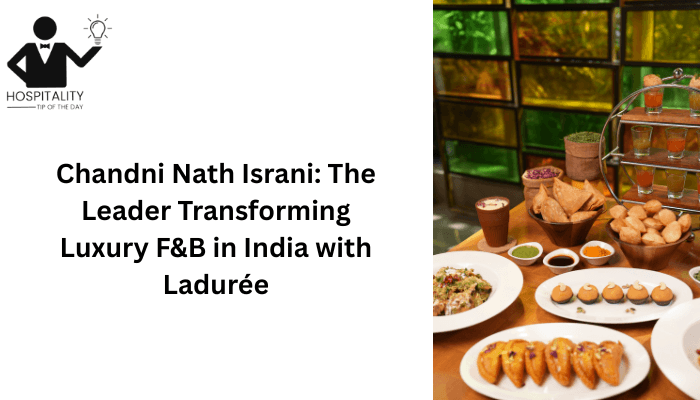
Under her leadership, Ladurée India has evolved into one of the country’s most resilient luxury hospitality success stories, while the CK Israni Group has emerged as India’s fastest-growing luxury F&B operator.
Understanding the Gap in India’s Luxury Dining Market
Luxury dining in India traditionally followed a predictable model:
Launch a flagship. Generate buzz. Expand quickly.
However, the model often failed to account for India’s layered consumption patterns. Luxury in India is not confined to grand occasions — it is fluid, frequent, and deeply contextual. Consumers seek experiences that integrate into their lifestyle rather than remain aspirational one-offs.
Chandni Nath Israni recognized this shift early.
Instead of chasing spectacle, she focused on sustainability. Instead of building for headlines, she built for habit.
Launching During a Global Crisis: A Bold Strategic Move
When Ladurée India launched in 2020, the global hospitality industry was navigating unprecedented uncertainty. Many brands were downsizing or retreating altogether.
Choosing to enter the market during such a period was not just bold — it was strategic.
Rather than delaying expansion, Chandni used the moment to establish strong operational foundations, secure prime high-performance locations, and craft a scalable, intelligent model.
Today, Ladurée India operates across nine locations in:
Delhi
Mumbai
Kolkata
Hyderabad
Bengaluru
These are not emerging secondary markets — they are India’s most competitive and complex luxury hubs.
Rewriting the Luxury F&B Playbook
Traditional luxury brands often rely heavily on grandeur and exclusivity. Chandni Nath Israni took a different route.
A Multi-Format Strategy
Instead of limiting Ladurée to flagship cafés, she introduced a diversified model:
Elegant salons
Retail carts
Full-service cafés
This ensured brand accessibility without diluting prestige.
By embedding the brand across multiple formats, Ladurée India became part of everyday luxury rather than a rare indulgence. Consumers could engage with the brand frequently — whether through a quick retail purchase or an immersive café experience.
Operational Intelligence Over Hype
One of the defining aspects of Chandni’s leadership is discipline.
Where many luxury F&B brands focus on high-decibel launches and rapid scaling, Ladurée India emphasizes:
Repeat customer loyalty
Operational refinement
Location intelligence
Long-term brand credibility
Luxury, in this model, is not a one-time spectacle. It is a repeatable, reliable experience.
This shift has fundamentally changed the brand’s relationship with its audience. Instead of chasing footfall spikes, the strategy nurtures consistent patronage — the true marker of longevity in hospitality.
Building Endurance in a Volatile Industry
India’s luxury dining sector is often characterized by rapid entries and quiet exits. The pressure to scale quickly can compromise operational depth, leading to fragility.
Under Chandni Nath Israni’s stewardship, Ladurée India demonstrates that aspiration and scale are not mutually exclusive. They must coexist.
Within the broader portfolio of the CK Israni Group, Ladurée stands as a defining pillar — not merely as a brand extension, but as a blueprint for sustainable luxury hospitality in India.
The Larger Shift in India’s Luxury Dining Landscape
As Ladurée India marks its ninth address, it signals more than expansion. It reflects a transformation in how luxury hospitality is built and sustained in India.
Success is no longer measured by survival alone.
The new benchmarks are:
Cultural fluency
Operational depth
Strategic patience
Executional rigor
In a market where many arrived with ambition and departed with silence, Chandni Nath Israni has achieved something far more complex — she has built a luxury F&B ecosystem designed to endure.
Not through spectacle.
Not through aggressive scale.
But through thoughtful disruption and disciplined execution.