
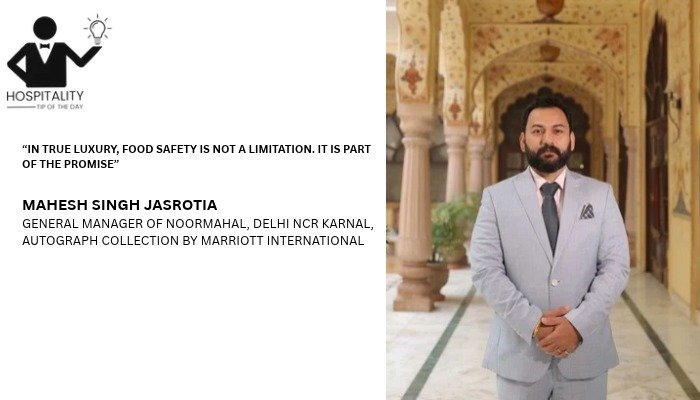
Hospitality Tip of the Day | Food Safety — The GM Perspective
In True Luxury, Food Safety Is Not a Limitation. It Is Part of the Promise.
Mahesh Singh Jasrotia, General Manager of Noormahal, Delhi NCR Karnal, Autograph Collection by Marriott International, on why uncompromising standards, empowered teams, and proactive leadership are at the heart of genuine five-star hospitality.
In ultra-luxury hospitality, the expectation is often simple: make it possible.
A bespoke dining request, a high-profile VIP, a large banquet, or a fully occupied hotel can place extraordinary demands on an operation. But for Mahesh Singh Jasrotia, General Manager of Noormahal, Delhi NCR Karnal, Autograph Collection by Marriott International, one principle remains constant: luxury can be flexible, personalized, and highly creative—but food safety cannot be negotiable.
For Jasrotia, genuine luxury is built on three things: seamless service, safety, and trust.
His approach moves beyond simply preparing for audits. It focuses on live monitoring, employee empowerment, supplier standards, near-miss reporting, and creating a culture where every associate understands that guest wellbeing comes before hierarchy or operational pressure.
For this edition of Food Safety — The GM Perspective, Hospitality Tip of the Day spoke with Mahesh Singh Jasrotia about the standards behind luxury hospitality and what it takes to maintain them when the pressure is at its highest.
1. “Anything Is Possible” — But Food Safety Has No Exceptions
In the ultra-luxury segment, guest expectations can be limitless. According to Mahesh Singh Jasrotia, that does not mean food-safety standards should become flexible.
Instead, the challenge is to deliver the guest’s desired experience within the established safety framework.
“True luxury is seamless, safe, and trustworthy.”
Whether the request comes from a regular guest or a VIP, the same food-safety protocols apply. When a request falls outside those parameters, the team’s responsibility is to find an alternative that remains equally thoughtful and bespoke.
For Jasrotia, saying “no” to an unsafe practice does not diminish luxury. Finding a safe way to deliver the experience demonstrates the professionalism behind it.
2. Watch the Indicators Before They Become Incidents
Food-safety leadership, in Jasrotia’s view, is fundamentally about prevention.
He personally reviews live temperature-monitoring dashboards covering storage and preparation areas, with deviations triggering immediate corrective action.
Hand-hygiene compliance is tracked through digital audit systems, while the executive team reviews results regularly. The hotel also conducts routine unannounced spot checks across outlets—not just kitchens—to ensure that standards remain consistent throughout the property.
Leadership attention also extends to:
Near-miss reports
Corrective-action logs
Food-safety training and certification
Supplier performance
Temperature monitoring
Hand-hygiene compliance
Unannounced operational checks
Near misses and corrective actions are reviewed in leadership meetings with the objective of identifying root causes before they develop into incidents.
The philosophy is straightforward: food safety should be continuously monitored, not periodically inspected.
3. A Great Audit Score Cannot Hide Repeated Deviations
A strong audit result can provide reassurance—but it cannot compensate for repeated operational lapses.
For Jasrotia, recurring issues such as unlabeled items, missed temperature checks, or small procedural deviations indicate that something deeper may be wrong with operational discipline.
“Audit scores offer reassurance, but repeated operational deviations signal a breakdown in discipline and culture.”
An audit captures a moment.
Food safety, however, has to work through every shift, every day.
His benchmark is therefore consistency. If standards are followed only when an audit is approaching, the system is not delivering the level of food safety expected from a luxury operation.
4. Giving Every Associate the Confidence to Challenge a VIP
One of the strongest indicators of a safety-first culture is whether an employee feels empowered to speak up.
At Noormahal, Delhi NCR Karnal, Autograph Collection by Marriott International, Jasrotia believes every team member—regardless of seniority or department—should have the confidence to pause or escalate a request if it could compromise food safety.
That principle becomes especially important when the request comes from a high-profile guest.
Scenario-based training helps associates understand how to manage these situations with confidence, professionalism, and composure.
And leadership support matters just as much as training.
“When a team member intervenes to uphold our protocols, I support them personally and without exception.”
For Jasrotia, protecting the person who speaks up reinforces a culture in which safety does not depend on hierarchy.
5. When the Hotel Is Full, the Standards Become More Visible
A 100% occupied hotel and a major banquet operation can test every system simultaneously.
This is when Jasrotia believes preparation and additional supervision become critical.
During high-pressure operations, the hotel deploys additional Hygiene Stewards and Supervisors, while temporary and event staff are trained to meet the property’s food-safety standards.
Digital checklists, temperature monitoring, and regular line checks provide real-time visibility during operations.
“My mantra: no shortcuts, no exceptions.”
The approach extends beyond the hotel kitchen.
For Jasrotia, food safety begins at the procurement stage. Vendor empanelment is supported by quality checks, ensuring that food-safety expectations are considered before ingredients and supplies even enter the operation.
That creates a broader view of food safety—one that starts with the supply chain and continues through preparation and service.
6. From Procurement to Plate, Safety Is One Continuous Chain
Food safety cannot be isolated to the final stage of service.
The systems Jasrotia describes create a chain that begins with supplier selection and continues through receiving, storage, preparation, monitoring, and guest service.
This means that procurement decisions become part of the food-safety conversation.
Reliable suppliers, trained employees, digital monitoring, hygiene checks, corrective actions, and leadership oversight all contribute to the same objective: ensuring that safety is built into the operation rather than added afterward.
For a luxury hotel, the guest may only see the final dish.
Behind that dish is an entire system designed to ensure that the experience is not only memorable, but trustworthy.
The GM Perspective
Mahesh Singh Jasrotia’s approach to food safety is ultimately about consistency, empowerment, and prevention.
The standard should not change because the hotel is full. It should not change because the guest is a VIP. And it should not become visible only when an auditor arrives.
From supplier selection to the kitchen, from digital monitoring to employee behaviour, food safety has to exist throughout the operation.
Because in genuine luxury hospitality, the promise to the guest is not simply that everything is possible.
It is that everything possible will be delivered responsibly, safely, and with integrity.
About the Leader
Mahesh Singh Jasrotia is the General Manager of Noormahal, Delhi NCR Karnal, Autograph Collection by Marriott International, leading operations in a luxury hospitality environment where guest experience, operational discipline, and service standards come together.
This article is part of Hospitality Tip of the Day’s ongoing editorial series, Food Safety — The GM Perspective—real conversations with General Managers about the leadership, systems, and culture behind safe hospitality. Interview edited for length and clarity.