
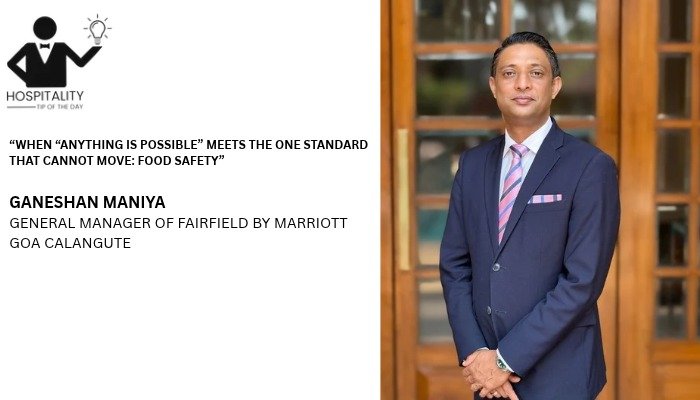
Hospitality Tip of the Day | Food Safety — The GM Perspective
When “Anything Is Possible” Meets the One Standard That Cannot Move: Food Safety
Ganeshan Maniya, General Manager of Fairfield by Marriott Goa Calangute, on building a food-safety culture where guest safety remains non-negotiable—even when the hotel is operating at full capacity.
Hospitality is built around creating memorable experiences. Guests expect personalization, flexibility, and the feeling that almost anything can be arranged for them.
But behind every exceptional experience is a responsibility that cannot be compromised: guest safety.
For Ganeshan Maniya, General Manager of Fairfield by Marriott Goa Calangute, the principle is straightforward. “Anything is possible” should never mean taking shortcuts on food safety. It should mean finding a safe way to deliver what the guest wants.
With experience across Food & Beverage and hotel operations, Maniya believes the strongest food-safety culture is not created through compliance alone. It is built when every associate understands that protecting the guest is part of hospitality itself.
For this edition of Food Safety — The GM Perspective, Hospitality Tip of the Day spoke with Ganeshan Maniya about leadership, early warning signs, VIP requests, high-pressure operations, and the difficult decisions that arise when food safety meets business realities.
1. “Anything Is Possible” Has One Boundary
Luxury and premium hospitality are about creating memorable experiences, but guest safety remains the foundation.
Guests may request customized dishes, special sourcing, or unique dining experiences. According to Ganeshan Maniya, the answer should not be an immediate “no”—but neither should it involve compromising established food-safety standards.
The responsibility of the team is to find a safe alternative.
“Let us find a safe way to make this happen.”
For Maniya, this mindset becomes particularly powerful when it is embedded in the culture of the hotel rather than treated as a compliance requirement.
When associates understand that protecting the guest is the highest form of hospitality, food safety becomes part of every decision.
2. The Warning Signs Often Appear Before the Incident
Food-safety incidents rarely emerge without any preceding signals.
Rather than waiting for audit findings or guest complaints, Maniya focuses on leading indicators that can reveal potential risks earlier.
These include:
Temperature-monitoring compliance
Hygiene observations
Corrective-action closures
Supplier performance
Pest-control trends
Employee training completion
Equipment maintenance records
Repeated small deviations can be particularly important because they may indicate a larger weakness developing within the operation.
But Maniya also looks beyond reports.
“Processes reveal compliance, but behaviour reveals culture.”
How employees behave when supervisors are not present can reveal whether food safety has genuinely become part of the hotel’s culture.
3. Empowering the Associate to Challenge a VIP
A strong food-safety culture exists when every associate feels empowered to stop an unsafe practice—regardless of who the guest is.
For Maniya, no position, status, or VIP request should take precedence over guest safety.
If a request falls outside safe practices, the associate should respectfully explain the concern and work toward a safe alternative.
That requires something equally important from leadership: support.
Employees need to know that management will stand behind them when they make a decision that protects the guest.
“Food safety should never depend on hierarchy; it should be a shared responsibility across the hotel.”
When people feel supported, they are more likely to speak up when pressure is at its highest.
4. 100% Occupancy Is Where Discipline Is Truly Tested
Full occupancy, large banquets, and high-pressure operations can put enormous pressure on hotel teams.
Speed and service delivery naturally become priorities—but these are precisely the moments when food-safety discipline must remain consistent.
For Maniya, preparation is the answer.
Clear planning, staffing readiness, cross-functional coordination, and strong supervision help ensure that standards remain consistent even when business volumes increase.
And leadership visibility matters.
When the GM and senior leaders remain present and engaged during high-pressure periods, the team sees that food safety remains a priority alongside service delivery.
“Food safety cannot be treated as an additional task during busy periods. It must remain an integral part of every process, regardless of business volume.”
The objective is not to manage food safety despite high occupancy. It is to build an operation where food safety is already part of how high occupancy is managed.
5. When Food Safety and Revenue Collide
Some of the most difficult decisions in hospitality happen when guest preferences, revenue opportunities, operational convenience, and food safety come into conflict.
For Ganeshan Maniya, the principle is clear: food safety comes first.
Revenue can be recovered. Operational challenges can be resolved. Guest expectations can often be managed through communication and safer alternatives.
A food-safety incident, however, can have consequences extending far beyond a single service period—affecting guest trust, brand reputation, and employee confidence.
“As leaders, we are custodians of our guests’ wellbeing.”
For a General Manager, that responsibility extends beyond the immediate decision. Every operational choice contributes to the culture the hotel creates for both its guests and its teams.
The GM Perspective
Ganeshan Maniya’s approach ultimately comes down to one principle: food safety is not a separate function of hotel operations—it is part of leadership itself.
From customized guest requests to VIP experiences, from everyday operations to 100% occupancy and large events, the standard remains consistent.
The strongest food-safety culture is one where associates are empowered to speak up, leaders support the right decisions, and every guest experience is built around the same non-negotiable foundation: their safety.
About the Leader
Ganeshan Maniya is the General Manager of Fairfield by Marriott Goa Calangute, with experience spanning Food & Beverage and hotel operations.
This article is part of Hospitality Tip of the Day’s ongoing editorial series, Food Safety — The GM Perspective—real conversations with General Managers about the leadership, culture, and operational discipline behind safe hospitality. Interview edited for length and clarity.