
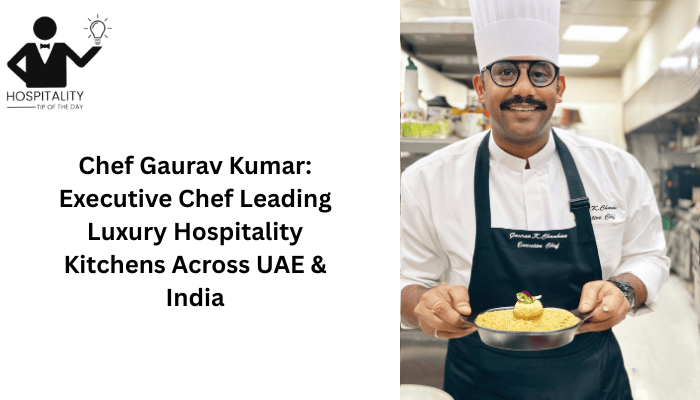
In the world of luxury hospitality, where timing, precision, and consistency define success, few culinary leaders embody operational excellence like Chef Gaurav Kumar. With more than 18 years of international hospitality experience across six countries, Chef Gaurav has built a reputation not through television fame or social media theatrics, but through disciplined kitchen leadership, cost efficiency, and the ability to lead high-performing culinary brigades under pressure.
From the luxury hotels of Abu Dhabi and Dubai to the culturally rich kitchens of Kashmir, Mumbai, Pune, and Indore, Chef Gaurav Kumar’s culinary journey reflects the evolution of modern hospitality leadership — where systems matter just as much as creativity.
A Culinary Career Built on Discipline and Consistency
There is a unique atmosphere inside every professional kitchen moments before service begins. The energy shifts. Conversations become minimal. Every chef knows their station, every movement becomes intentional, and the brigade prepares for flawless execution.
For Chef Gaurav Kumar, this silence represents discipline.
Having worked with globally renowned hospitality brands including Marriott, JW Marriott, Hilton, Conrad, Sheraton, and Radisson Blu, Chef Gaurav has consistently delivered operational excellence across multi-outlet luxury properties.
His leadership philosophy is rooted in one simple belief:
“A kitchen is only as strong as the systems beneath it. The food on the plate is the last 10%. The other 90% is discipline, forecasting, and trust.”
This operational mindset has allowed him to manage large culinary teams, maintain profitability targets, and execute large-scale hospitality operations without compromising quality.
Mastering Food Cost Management in Luxury Hospitality
One of the most challenging aspects of modern hotel operations is maintaining healthy food costs while delivering premium guest experiences.
Chef Gaurav Kumar has consistently maintained food costs between 25–28% across multiple luxury hospitality environments — an achievement that requires far more than budgeting skills.
His approach combines:
- Strategic production planning
- Yield management systems
- Vendor negotiations
- FIFO inventory discipline
- Real-time waste monitoring
- Occupancy-based forecasting
At Abu Dhabi National Hotels, Chef Gaurav introduced a redesigned production planning system that significantly reduced food waste within the first 90 days of implementation. Rather than treating waste reduction as a temporary initiative, he integrated it directly into daily kitchen operations across six F&B venues while leading a brigade of more than 100 culinary professionals.
This is where strong hospitality leadership separates average kitchens from world-class culinary operations.
The Difference Between Managing and Leading a Kitchen
Most hospitality businesses review food cost reports after the damage is already done. Elite culinary leaders build cost control directly into operational planning before ingredients even enter production.
Chef Gaurav’s kitchens operate on proactive forecasting instead of reactive management.
By aligning procurement, prep schedules, and production quantities with occupancy trends and banquet forecasting, his teams are able to reduce waste while maintaining premium service standards.
This level of precision becomes even more critical in high-volume luxury hospitality environments where thousands of covers may be served within a single event cycle.
From Kashmiri Wazwan to Dubai Fine Dining Excellence
One of the defining aspects of Chef Gaurav Kumar’s career is his ability to adapt across dramatically different culinary environments.
At Four Points by Sheraton Srinagar, he worked within the logistical complexities of Kashmir, where supply chain limitations and seasonal disruptions demanded exceptional procurement planning and operational flexibility.
Managing traditional Kashmiri Wazwan cuisine while maintaining strict food cost controls required creativity, adaptability, and deep cultural understanding.
In contrast, Dubai presented an entirely different challenge.
At premium hospitality venues like NOC NOC Café & Club and Chokhi Dhani Dubai, the focus shifted toward luxury presentation, upscale dining experiences, and high-energy service environments where consistency had to be maintained even during peak late-night operations.
Chef Gaurav successfully elevated traditional Rajasthani cuisine into a five-star dining experience without losing its authenticity.
One of his standout achievements included executing a 150-guest, five-course Modern Indian gala dinner with zero service failures — the kind of operational benchmark highly respected within the hospitality industry.
As Chef Gaurav explains:
“Heritage cuisine in a luxury setting is not fusion. It is translation. You are not changing the language — you are finding the right audience for it.”
Career Highlights of Chef Gaurav Kumar
Abu Dhabi National Hotels, UAE (2025–Present)
Currently leading a culinary brigade of over 100 professionals across six F&B venues while consistently maintaining food costs within the 25–28% range.
NOC NOC Café & Club, Dubai (2023–2025)
Managed premium fusion and Continental dining operations while increasing guest spending through upscale sharing-format menus.
Chokhi Dhani Dubai (2022–2023)
Successfully transformed traditional Rajasthani cuisine into a refined luxury hospitality experience while executing high-profile gala dinners for major corporate events.
Sheraton Grand Palace, Indore (2021–2022)
Played a key role during Marriott brand conversion and led large-scale banquet operations handling up to 5,000 covers.
Four Points by Sheraton, Srinagar (2018–2020)
Specialized in Kashmiri Wazwan cuisine and collaborated with celebrity chef Sanjeev Kapoor on branded culinary promotions.
The Importance of Pre-Opening Hospitality Experience
Beyond operational leadership, Chef Gaurav Kumar also brings valuable pre-opening hospitality expertise — one of the rarest and most valuable skill sets in the hotel industry.
During his time at Keys Namaste Dwaar, he contributed to:
- Kitchen equipment planning and installation
- Workflow and production layout design
- Vendor onboarding and procurement systems
- Brigade recruitment and training
- HACCP implementation and compliance readiness
Professionals who have successfully executed hotel pre-openings develop a unique understanding of operational vulnerabilities because they have built systems from the ground up.
This experience enables stronger long-term decision-making in future leadership roles.
Leadership Lessons for the Hospitality Industry
Chef Gaurav Kumar’s career highlights an important reality within modern hospitality management:
Great kitchens are not built solely on culinary talent. They are built on systems, structure, training, discipline, and accountability.
A brigade of over 100 chefs cannot function efficiently through creativity alone. It requires:
- Standard Operating Procedures (SOPs)
- Strong communication systems
- HACCP-driven safety culture
- Operational forecasting
- Waste accountability
- Leadership consistency
For hotel owners, F&B directors, and hospitality professionals evaluating culinary leadership, the most important question is not whether a chef can cook exceptional food.
The real question is:
Can they build systems that consistently deliver excellence at scale?
Chef Gaurav Kumar’s journey across international luxury hospitality demonstrates exactly what that looks like in practice.
Final Thoughts
Eighteen years. Six countries. More than 5,000 banquet covers. Over 100 culinary professionals led across multiple luxury hospitality brands.
From the traditional kitchens of Kashmir to the high-performance hospitality scene of Dubai and Abu Dhabi, Chef Gaurav Kumar has quietly established himself as a leader who understands that true culinary excellence is built behind the scenes — through discipline, operational mastery, and systems that never fail under pressure.
That is what leadership behind the pass truly looks like.