
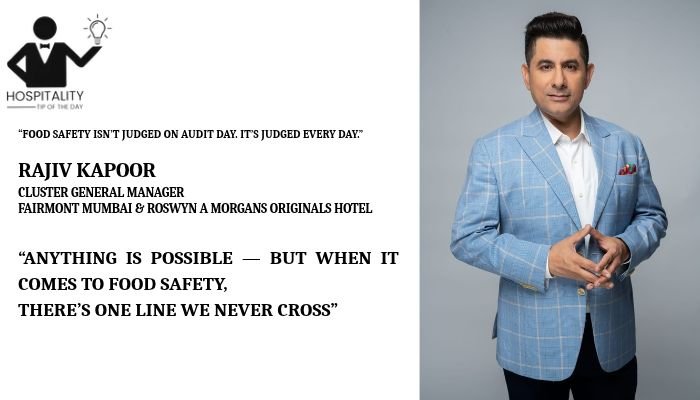
HOSPITALITY TIP OF THE DAY Series: Food Safety — The GM Perspective
Food Safety Isn’t Judged on Audit Day. It’s Judged on the Day the Auditor Isn’t There.
Rajiv Kapoor, Cluster General Manager for Fairmont Mumbai and Roswyn A Morgans Originals Hotel, on why “anything is possible” has exactly one line that never moves.
In ultra-luxury hotels, “no” isn’t supposed to exist. A guest wants a completely custom-built menu, shaped entirely around their allergies and dietary restrictions, ordered with no notice at all. A VIP wants an amenity that’s never been made before. The entire promise of the property is “yes.”
Rajiv Kapoor’s job is making sure that “yes” never touches the one thing that can’t move — food safety. As Cluster GM for Fairmont Mumbai and Roswyn A Morgans Originals Hotel, he runs a genuinely complex luxury culinary operation — multiple restaurants, large-scale banquets, room service, minibars, private dining, and guest requests that get more specific every year.
For this edition of Food Safety — The GM Perspective, we asked him ten direct questions. No PR polish. Here’s what he said.
1. “Anything Is Possible” Has One Rule
Luxury, Rajiv Kapoor says, isn’t about saying yes to everything — it’s about finding a way to make things possible without touching what can’t be touched. Across Fairmont Mumbai’s restaurants, banquets, and room service, and Roswyn A Morgans Originals Hotel’s more personal format, a guest’s allergy or special request should never be met with “it can’t be done.” The real question his team is trained to ask is how to deliver it safely.
“‘Anything is possible’ should mean that we will find a safe solution — not that we will make an exception to a safety standard.”
Everything else in this interview is really an explanation of how he holds that line.
2. The Warning Signs Before the Incident
Rajiv Kapoor doesn’t wait for an audit to tell him something’s wrong. Fairmont Mumbai holds a HACCP certification with a 96.5% score and a 5-Smiles hygiene rating — solid external benchmarks — but he’s clear an audit score alone is not a measure of food-safety health.
What he actually watches: trends in temperature monitoring, corrective actions, ATP-based hygiene verification, frying-oil quality, pH controls, food-sampling results, buffet controls, and recurring operational deviations. Digital date tagging and digital monitoring matter here because they add visibility and traceability that manual logs can’t.
The distinction he draws is the one most GMs miss:
“A single deviation may be an isolated mistake. A repeated deviation tells us there may be a weakness in the process, training, or culture.”
3. A Great Audit Score Doesn’t Mean You’re Safe
Not necessarily, Rajiv Kapoor says — and he doesn’t soften it. An audit captures one point in time. Food safety has to hold up every day, every shift. A great score should build confidence, not complacency. If the same issues around temperature ,date tagging, storage, or hygiene keep resurfacing, he wants to know why — digital monitoring is what turns “we noticed a problem” into “we can see the trend and hold ourselves accountable for closing it.”
“The real test of food safety is not how we perform on audit day; it is how we operate when the auditor is not there.”
4. When a Team Member Has to Push Back on a VIP
The standard here is simple and non-negotiable: a VIP guest deserves exceptional service, never a different safety standard. If a colleague spots a risk in a VIP request, the expectation is to raise it — respectfully, with the chef or hygiene team — and look for a safe alternative instead of a flat no. That only works if leadership actually backs the person who speaks up.
“I would much rather have a colleague stop and ask one extra question than remain silent when something does not feel right.”
5. 100% Occupancy, Big Banquets, No Excuses
In Rajiv Kapoor’s view, pressure — even at 100% occupancy, during big banquets and high-pressure periods — is not a reason to loosen anything; if anything, it raises the bar for preparation. Banquets and peak periods demand tight coordination across culinary, stewarding, service, stores, and hygiene teams, built on solid production planning, adequate resources, clear briefings, and defined responsibility. Buffets get extra attention because volume and speed amplify risk; sample retention adds another layer of traceability.
His own role in a crunch isn’t to help the team work around controls — it’s to make sure the operation was planned well enough that safety stays built in, even at peak load.
6. The Risk Doesn’t End When Food Leaves the Kitchen
Rajiv Kapoor treats food safety as a full journey — receiving, storage, preparation, transport, service, consumption — across restaurants, banquets, room service, buffets, minibars, private dining, and VIP amenities. Temperature control while food is moving, allergen communication, date tagging, and correct storage all matter here, and it’s exactly where ATP testing, digital monitoring, and external food testing catch what isn’t visible on the surface.
The controls change by touchpoint — banquets need production discipline at volume, room service needs handling and delivery discipline, minibars and VIP amenities need storage and date rotation, private dining needs the same rigor despite being more personal — but the underlying standard never does. HACCP certification, HRA assessments, ATP verification, and monthly external food sampling sit underneath all of it, and growing digitalization — digital monitoring, digital date tagging — is reducing how much depends on manual systems. Technology, though, is only ever the enabler.
“The strongest control is a colleague who understands the risk, knows the standard, and takes ownership of it. Food safety does not belong to one department — it belongs to everyone who touches the guest experience.”
7. Customizing for UHNW Guests Without Guessing
Personalization, for Rajiv Kapoor, starts with correctly understanding the guest — allergies, dietary restrictions, specific ingredients, religious or lifestyle preferences, a fully custom menu — and making sure that information travels intact from the guest-facing team to culinary and everyone in between. The instinct to move fast for a VIP is exactly the moment he wants his team to slow down and get more disciplined, not less. No ingredient gets assumed safe just because it’s familiar.
“The guest should experience the personalization; they should not have to see the complexity behind it.”
8. The 10-Minute Test
Not paperwork. Rajiv Kapoor starts on the floor — hand hygiene, food temperatures, storage, separation of raw and ready-to-eat food, date tagging, labelling, surface cleanliness, buffet practice — and whether teams are actually monitoring or just filling in logs. Then he asks staff three direct questions:
What’s the biggest food-safety risk in your area?
What would you do if you found a temperature outside the required limit?
Who would you tell if you spotted a food-safety concern?
Their answers, he says, reveal more about the real culture than any completed checklist. Digital records, HACCP performance, HRA results, and ATP verification all matter as evidence — but with only ten minutes, people and practice come first.
“Documentation can tell you what was recorded. People tell you what is happening.”
9. When Safety Collides With Revenue
This is the hardest line in the whole conversation. If there’s a genuine food-safety risk, the decision isn’t complicated — guest safety wins. Revenue can be recovered. Inconvenience can be managed. A guest preference can usually be met a different, safer way. HACCP certification and HRA performance provide the framework, Rajiv Kapoor says, but the final call always rests on risk and guest wellbeing. The GM’s job isn’t to say no — it’s to find the safe yes.
“How can we deliver what the guest wants safely? I see food safety as part of our luxury promise — not as something separate from it.”
Rajiv Kapoor is Cluster General Manager, Fairmont Mumbai and Roswyn A Morgans Originals Hotel. Part of Hospitality Tip of the Day’s ongoing series, Food Safety — The GM Perspective — real conversations with the GMs who have to get this right, every single day. Interview edited for length and clarity.