
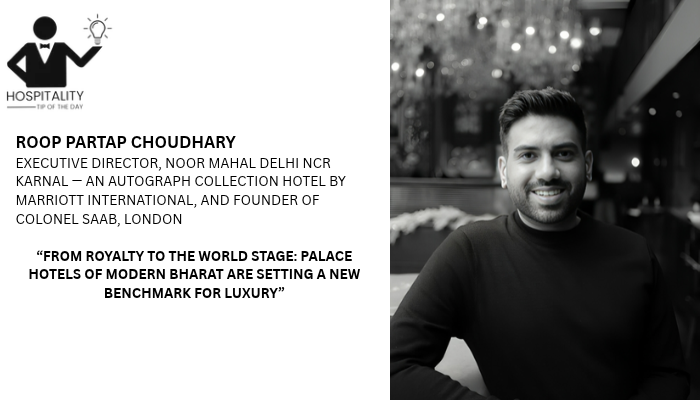
Roop Partap Choudhary Executive Director, Noor Mahal Delhi NCR Karnal — An Autograph Collection Hotel by Marriott International, and Founder of Colonel Saab, London
India’s palace hotels have always carried something beyond architecture — they hold the living memory of the country’s royal past. What’s changed is that these properties are now stepping onto the world stage as genuine benchmarks in luxury, not just heritage curiosities. The real challenge for the industry lies in balancing preservation with progress: keeping the charm of heritage intact while giving today’s guest what they actually expect now — not a passive look at history, but a way to take part in it.
The scale of this shift shows up in the numbers too. Grand View Research projects India’s heritage tourism market to reach USD 57.14 billion by 2033, growing at 6.8% annually between 2025 and 2033, with heritage already responsible for more than half of that revenue. Guests today aren’t just picking a destination — they’re looking for something meaningful and immersive, a stay that becomes part of their own story rather than something they simply observe from the outside.
Palaces once built exclusively for kings and queens now open their doors to travellers from every continent, and for the first time in decades, the direction of inspiration has reversed: where Indian luxury hospitality once looked to Paris, London and New York, the world is now looking to India.
TODAY’S TIP: A guest today doesn’t want a guided tour of someone else’s history — they want to feel like a part of the story themselves, even briefly. That single shift is what’s redefining luxury across the hospitality industry.
Redefining Grandeur: Experience Over Exhibition
Elegance, in the old definition, was measured in excess — the gleam of crystal, gold-plated cutlery, the exclusivity of a velvet rope. Today’s guest measures it differently. They’ll still happily sleep in a room a maharaja once called his own — but what they want more is context: the history behind that hand-painted ceiling, a seat at a festival happening right there on the grounds, and a plate that tastes like it came from a royal kitchen generations ago, not a menu written last month.
That expectation is pushing hoteliers from passive display toward active participation: heritage walks guided by palace historians, live demonstrations from local artisans, and evenings built around classical Indian music and dance. Even the food has changed character — kitchens are reimagining old recipes with modern technique rather than simply recreating them, using ingredients pulled from the farms and markets just outside the property.
Technology Meets Tradition
This renaissance runs on more than nostalgia — it runs on infrastructure. Underneath 18th-century architecture, the actual guest experience operates on 21st-century systems: mobile check-in, personalised digital itineraries and high-speed connectivity now sit right alongside the traditional aarti welcome and the scent of jasmine in the courtyard, rather than replacing it. None of this erases the past — it protects it, by freeing staff from operational load so they can focus on what no system can do: anticipating a guest’s needs, telling the property’s story, and making someone feel like royalty for the length of their stay.
Sustaining Craft and Community
This shift reaches well beyond the hotel gates. Spotlighting local crafts — intricate zardozi embroidery and hand-carved stonework among them — keeps endangered skills alive, and real partnerships with artisans build sustainable livelihoods rather than just decorative flourishes for guests. Weddings and international conferences hosted on palace grounds create steady demand for local textiles and farm-fresh produce, so heritage and economic progress end up reinforcing each other. These hotels have quietly become drivers of growth for their regions — pulling in investment for local infrastructure and education, and opening doors for young professionals nearby.
Setting New Global Benchmarks
The international hospitality community is watching closely. Sustainability, cultural immersion and genuine community engagement — once treated as niche add-ons — now sit at the centre of the business model, and some of the world’s most respected hotel schools, travel publications and industry voices are studying Indian palace hotels as live case studies in how a legacy brand stays relevant through disruption.
Two examples capture this journey well: Noor Mahal, Delhi NCR Karnal, redefining what palatial hospitality looks like on Indian soil, and Colonel Saab, turning Indian heritage dining into a landmark destination in the heart of London. For the next generation of hoteliers carrying this forward, the goal isn’t to imitate the past but to make it matter again — through rigorous staff training, an uncompromising focus on service, and a willingness to innovate in everything from spa offerings to environmental practice.
None of this comes easily. Maintaining centuries-old structures takes real investment and expertise, and balancing the preservation of priceless art and architecture against modern safety codes and guest expectations is a constant negotiation. As the industry scales, the harder discipline is staying rooted — resisting the pull of passing trends, and keeping the guest experience tied to place, story and a genuine connection to local culture, rather than diluting it for the sake of growth.
The renaissance is still gathering pace. Every year, more travellers choose immersion over imitation, meaning over materialism, and India’s palaces — once symbols of exclusivity — are becoming beacons for a different kind of regal splendour: one that honours heritage, welcomes innovation, and opens its doors to the world. The real measure of success won’t just be how well this past is preserved, but how enduring the new standard built around it turns out to be. As Roop Partap Choudhary puts it, luxury hospitality has moved past the idea of excess altogether, toward something rooted in “Culture, Connection and Community.”
About Roop Partap Choudhary
Roop Partap Choudhary is a second-generation hotelier from the Jewel Group of Hotels family, currently Executive Director of Noor Mahal, Delhi NCR Karnal — An Autograph Collection Hotel by Marriott International — and Founder of Colonel Saab, London. Before joining the family business, he built his grounding at established names including ITC Maurya, Kingdom of Dreams and Galaxy Hotel. He holds a Master’s degree in hospitality from the University of Ashland, with a further specialisation in Asian tourism from Nanyang University, Singapore.
Colonel Saab began as a personal tribute — to his father, a decorated officer of the Indian Army, and his mother — and has since grown into one of London’s top 10 Indian restaurants, with recognition from Forbes International. Noor Mahal’s own trophy cabinet includes Best Upcoming 5-Star Resort (2014), Best 5-Star Heritage Resort (2017), Best Destination Wedding Hotel in North India (2018) and Event Venue of the Year – Luxury at the ET Travel Awards (2023), while Roop himself was named in Travel India’s 30 Under 30 list — among the youngest hoteliers to receive it — and included in the 21 Business Leaders of Rising India, 2023.
Outside the hotel, he’s a committed collector of art and antiques (visible throughout both Noor Mahal and Colonel Saab’s interiors), and chairs NGO work in female empowerment and youth employment, including support for MD Bal Bhawan’s work with orphaned children. He describes Noor Mahal simply as his passion, his home and his family’s heritage — with one clear ambition ahead: turning it into a globally sought destination for leisure, MICE and weddings, while giving something back to the country and community that shaped him.