
India Hospitality Industry Growth & Future Trends: An Exclusive Interview with K.B. Kachru | Hospitality Tip of the Day
Feature Interview
Interviewer: Divya, CEO – Hospitality Tip of the Day
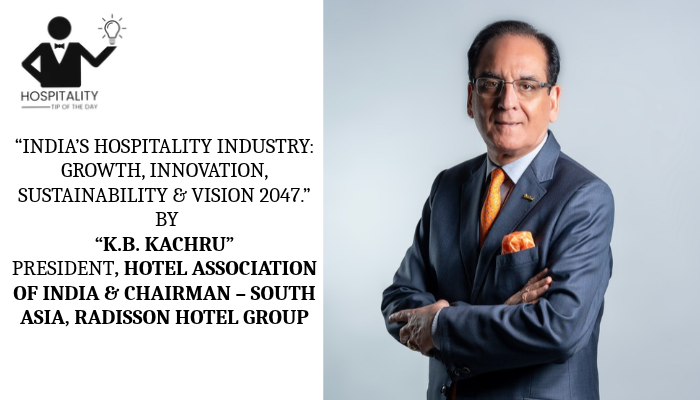
Spokesperson: K.B. Kachru, President, Hotel Association of India & Chairman – South Asia, Radisson Hotel Group
India Hospitality Industry: Growth, Leadership and Future Opportunities
The Indian hospitality industry has witnessed remarkable transformation over the years, with growing opportunities in branded hotels, domestic tourism, sustainable hospitality and emerging travel destinations. As the sector continues to evolve, leadership, innovation and changing guest expectations are playing an important role in shaping its future.
In this exclusive interview, Divya, CEO of Hospitality Tip of the Day, speaks with K.B. Kachru, President, Hotel Association of India and Chairman – South Asia, Radisson Hotel Group, about his professional journey, the evolution of India’s hospitality industry, hotel business expansion, technology, sustainability and the future of Indian tourism.
Q1. Could you share your professional journey in hospitality and the key experiences that shaped your leadership philosophy?
K.B. Kachru: My professional journey spans several decades, beginning with the early years of institutional hospitality in India and continuing through the growth of international hotel brands and the formalisation of the organised hospitality sector. Over the years, some of my most formative experiences have included building and scaling hotel businesses, working closely with owners, and navigating different cycles of expansion, regulation and market change.
My leadership philosophy has been shaped by three constants: putting the guest at the centre of everything we do, treating owners as long-term partners, and recognising that hospitality is fundamentally a people business. The privilege of leading both an international brand portfolio in South Asia and the Hotel Association of India has further reinforced the importance of maintaining an industry-wide perspective alongside organisational responsibility.
Q2. How has India’s hospitality industry evolved over the years, and what major opportunities do you see for the sector in the coming decade?
K.B. Kachru: India’s hospitality industry has evolved from a largely unorganised and metro-centric sector into a more formal, multi-segment industry with a growing presence across Tier II, Tier III and emerging destinations. Domestic demand has become the primary growth engine, while spiritual, leisure, wedding and MICE travel have opened entirely new markets for the sector.
Looking ahead, there are significant opportunities in continued branded hotel expansion, the professionalisation of secondary markets, stronger international inbound tourism, and tourism’s larger contribution to GDP and employment, aligned with India’s 2047 ambition. The next decade will reward those who can combine scale with quality, local understanding and sustainable practices.
Q3. What factors are driving the growth of branded hotels across India’s metropolitan cities and emerging destinations?
K.B. Kachru: Rising domestic travel and changing guest expectations are among the key factors driving the growth of branded hotels in India. Today’s traveller increasingly prefers branded hotels that offer predictable quality and consistent service standards over informal accommodation options.
At the same time, improving infrastructure, including airports, highways and rail connectivity, is unlocking opportunities in secondary and tertiary cities. Owner and investor confidence in branded hotel models is also increasing because these models bring established systems, distribution networks and operational expertise. In emerging destinations, the combination of pilgrimage, leisure and business demand is creating viable hotel economics in markets where such opportunities did not exist a decade ago.
Q4. How does Radisson Hotel Group differentiate its hospitality offerings in an increasingly competitive Indian market?
K.B. Kachru: Radisson Hotel Group benefits from a multi-brand portfolio that allows it to offer the right product for the right market and owner, ranging from upper-upscale to midscale and soft brands. The Group also has a deep presence beyond India’s traditional metropolitan markets, supported by nearly three decades of operating experience in the country.
Another important differentiator is our strong owner partnership culture. A high proportion of our owners operate multiple hotels with the Group, reflecting the strength of these long-term relationships. Our focus remains on disciplined, quality-led growth rather than simply expanding the number of hotels.
Q5. How are changing traveller expectations influencing hotel design, service standards, and the overall guest experience?
K.B. Kachru: Today’s guests expect personalisation, value, seamless digital interactions and authentic local experiences, alongside consistent service standards. These changing expectations are influencing hotel design, operations and the overall guest experience.
Hotel design is increasingly moving towards more flexible spaces, greater relevance in food and beverage offerings for Indian preferences, and stronger attention to wellness and sustainability. However, service excellence remains the real differentiator. Technology should augment the human touch, not replace it. The Indian domestic guest has now become the design reference point for many hotel products, with international travellers being catered to on top of that foundation.
Q6. What role do franchise partnerships, management contracts, and collaborations with hotel owners play in expanding hospitality brands across India?
K.B. Kachru: Asset-light models, including management contracts and franchise partnerships, are essential for scaling in a capital-intensive sector like hospitality. However, the quality of the owner relationship is just as important as the commercial model. Long-term partnerships ultimately produce better hotels and better returns.
Flexible partnership structures allow brands to match different owner capabilities, risk appetites and market realities. In addition, conversions of existing hotel assets have become an important growth lever, creating value for owners while allowing hospitality brands to accelerate their presence across India.
Q7. How can the hospitality industry balance business growth with sustainability, responsible tourism, and local community development?
K.B. Kachru: Sustainability is no longer optional for the hospitality industry. It is directly linked to operational efficiency, guest preferences and the long-term value of hotel assets. Hotels need to focus on practical measures such as energy and water efficiency, waste management, responsible sourcing and community employment.
Responsible tourism also means developing hotels that respect local culture and the environment while creating economic opportunities for surrounding communities. Business growth and responsibility are not in conflict when hotels are planned and operated with a long-term perspective.
Q8. What are the biggest challenges facing hotel operators today, particularly in talent acquisition, employee retention, and maintaining service excellence?
K.B. Kachru: Talent remains the most critical constraint to sustained growth in the hospitality industry, both at the shop-floor level and in building future leaders. Employee retention requires competitive career opportunities, meaningful development pathways and a workplace culture that genuinely values people.
Maintaining service excellence at scale depends on strong training systems, clear standards and empowered local leadership. The industry and government must work together on skilling initiatives. The Hotel Association of India continues to advocate for structured national approaches to hospitality education and employability.
Q9. How are technology and digital innovation transforming hotel operations, distribution strategies, and customer engagement?
K.B. Kachru: Technology is playing an increasingly important role in improving revenue management, distribution, personalisation and operational efficiency. Direct digital channels and better use of data are helping hotels strengthen their relationships with guests while reducing dependence on intermediaries.
Artificial intelligence and automation will increasingly handle repetitive tasks, allowing hotel teams to focus on higher-value guest interactions. However, the guiding principle must remain “high tech, high touch”. Technology should free people to deliver better hospitality, not replace the human element that defines the industry.
Q10. Looking ahead, what is your vision for India’s hospitality industry, and which emerging trends or opportunities do you believe will shape its future?
K.B. Kachru: My vision is to see India emerge as one of the world’s defining hospitality markets by 2047, not only in terms of size but also in quality, sustainability and its ability to become a reference point for others.
Some of the key trends shaping the future will include deeper penetration of branded hotels into secondary and spiritual destinations, the rising importance of domestic experiential travel, greater integration of sustainability and technology, and stronger talent pipelines. Success will depend on moving from ambition and announcements to consistent implementation across infrastructure, capital access, skilling and policy coordination.
The hospitality industry is ready to partner with the government and other stakeholders to realise this potential.
Conclusion: The Future of India’s Hospitality Industry
India’s hospitality sector is entering an important phase of transformation, driven by domestic travel demand, branded hotel expansion, technology, sustainability and changing guest expectations. The industry’s long-term success will depend on quality-led growth, stronger infrastructure, investment, skilled talent and effective collaboration between the industry and government.
As India moves towards its 2047 vision, the hospitality sector has an important opportunity to strengthen its global position while creating meaningful economic and employment opportunities.
Interview by: Divya, CEO – Hospitality Tip of the Day
Featuring: K.B. Kachru, President, Hotel Association of India & Chairman – South Asia, Radisson Hotel Group.