
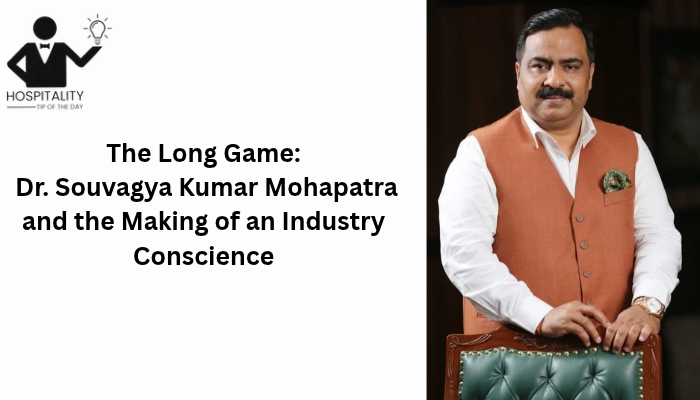
The Long Game: Dr. Souvagya Kumar Mohapatra and the Making of an Industry Conscience
There is a particular kind of authority that cannot be manufactured — it accumulates, slowly and irreversibly, through decades of decisions made under pressure, in rooms where the stakes were real and the answers were not obvious. Dr. Souvagya Kumar Mohapatra, Ph.D., carries that authority. As Managing Director for India, Nepal, Bhutan, and Sri Lanka at Atmosphere Core — a group whose luxury Maldivian properties are counted among the finest in the world — he brings to the table something that no title alone can confer: the institutional memory, the governance instincts, and the strategic depth of a man who has spent over thirty years building, operating, leading, and ultimately shaping one of India’s most consequential regional hospitality empires.
His is not a career that lends itself to easy summary. It spans the full arc of what it means to build a hospitality organisation from the inside — from operational management of individual properties to the COO and Executive Director roles that placed him in command of multi-property portfolios across twelve destinations and five states, overseeing more than three thousand employees and carrying personal accountability for income budgets, cost structures, procurement strategy, and the long-horizon capital projects that determine what a hospitality group looks like a decade from now. That career was built principally through MAYFAIR Hotels & Resorts Ltd., one of eastern India’s most respected hospitality groups, where Mohapatra’s tenure spanned nearly two decades and every rung of the leadership ladder — beginning in progressive operational roles, advancing through General Manager of the flagship Bhubaneswar property, ascending through Vice President of Sales & Marketing and Executive Vice President of Business Planning & Development, and ultimately arriving at the Executive Director level where his mandate was, in practical terms, the strategic and operational stewardship of the entire organisation.
What Thirty Years of P&L Leadership Actually Means
It is worth pausing on what that kind of tenure actually produces in a leader. Managing a single luxury property — its food and beverage operation, its banqueting venues, its service standards, its financial budgeting and asset audit cycles — is a complex enough undertaking. Mohapatra did that, and then spent the better part of two decades expanding outward: first into group-level sales and marketing, where he fixed budgets and targets across regional offices in three cities and represented MAYFAIR’s brand interests with convention bureaus, tourism offices, airlines, and media; then into business planning and development, where he took ownership of large-scale capital projects from design and interiors coordination through on-schedule delivery; and finally into the overarching Executive Director role, where income and expenditure governance, procurement standardisation, and multi-state operational coordination all fell within his remit.
The significance of this progression is not merely biographical. It means that when Mohapatra sits in a boardroom today and forms a view on capital allocation, risk, or strategic positioning, that view is not theoretical. It is grounded in the lived experience of having made those calls across a diversified, real-world portfolio — and having lived with the consequences. That is the kind of judgment that boards and organisations seek, and increasingly struggle to find, when they look for genuine governance capability rather than credentialed opinion.
The Sustainability Mandate
His current role at Atmosphere Core adds a dimension to his leadership profile that reflects where the global luxury hospitality industry is heading. Atmosphere Core manages properties in the Maldives across three distinct brands — The Ozen Collection, Atmosphere Hotels & Resorts, and Colours of Oblu — and Mohapatra leads the group’s expansion across South Asia. The mandate is not simply commercial: it encompasses driving the adoption of global sustainability standards, including Green Globe certification and large-scale solar power installation, and setting strategic direction on ESG, community skill-development, and regional tourism-body partnerships across four countries.
This is not a peripheral corporate responsibility exercise bolted onto an otherwise conventional hospitality operation. In the Maldivian luxury segment, sustainability is a brand-defining commitment — guests choose properties in part on the basis of how seriously a group takes its environmental obligations, and the reputational and commercial consequences of falling short are material. The fact that Mohapatra is the person tasked with driving this agenda across four countries — while simultaneously managing South Asia expansion strategy and stakeholder relations with tourism bodies, governments, and communities in India, Nepal, Bhutan, and Sri Lanka — speaks to the breadth of capability his current organisation is drawing on.
Industry Architecture: The Committee Work That Actually Matters
What distinguishes Mohapatra’s career from that of many equally accomplished hoteliers is the seriousness with which he has engaged with the institutional architecture of the Indian tourism and hospitality industry. This is not a peripheral part of his professional life — it is a parallel track of contribution that has run alongside his executive roles for years, and that has placed him at the centre of some of the industry’s most consequential policy and governance conversations.
He has chaired the Eastern Region Tourism Committee of FICCI — the Federation of Indian Chambers of Commerce and Industry — and served on its National Tourism Committee. He has chaired the equivalent body at ASSOCHAM and co-chaired the Tourism Subcommittee of the Confederation of Indian Industry. He has served on the Executive Committee of FHRAI — the Federation of Hotel & Restaurant Associations of India — the industry’s primary national representative body, for several years. He has been a Managing Committee Member of the Hotel & Restaurant Association of Eastern India and an active member of the Odisha State Tourism Promotion Council. He serves on the governing bodies of the Institute of Hotel Management campuses in Bhubaneswar and Balangir — a direct contribution to the talent pipeline that the hospitality sector depends on.
Each of these roles, taken individually, represents a significant contribution. Taken together, they constitute something more substantial: a sustained, multi-decade engagement with the governance of an entire industry across eastern India and nationally — shaping policy positions, representing industry interests to government, contributing to standards-setting, and helping to build the institutional frameworks within which thousands of hospitality businesses operate.
Recognition and the Weight It Carries
The awards and honours that have accumulated across Mohapatra’s career are, in their range and source, a reliable indicator of the breadth of esteem in which he is held. He has been named to the Architects of the Indian Hospitality Industry Power List by Hotelier India. He was recognised as Best Hotelier India by BBC Good Food India. He was awarded Fellowship of IIHM — the International Institute of Hotel Management — and the International Hospitality Council, London. He received a Lifetime Achievement Award and Honorary Fellowship from ICFAI University, Sikkim. He was named a Times Hospitality Icon by The Times of India. In the awards that carry particular institutional weight, he received the Chinta O Chetana National Award for Tourism from the Ministry of Information & Broadcasting and Ministry of Home Affairs, Government of India, and the Pioneer in Innovation in Luxury Hospitality & Tourism recognition from the Times Business Awards.
These are not industry-circuit participation trophies. They represent recognition by peers, by press, and by government of a career that has made a tangible difference — not just to the organisations Mohapatra has led, but to the sector he has served.
The Academic Dimension
It would be incomplete to discuss Mohapatra’s profile without acknowledging the Ph.D. in Hospitality and Tourism that sits alongside his executive credentials. In a sector where operational experience is rightly prized above academic qualification, the decision to pursue doctoral research represents something worth noting: a commitment to understanding the industry not just through the lens of P&L and operational performance, but through the more rigorous, questioning framework that serious academic inquiry demands. It is a dimension of his identity as an industry professional that informs the way he engages with policy questions, sustainability frameworks, and the longer-term structural challenges facing Indian tourism — and it is part of why, when Mohapatra speaks on matters of industry governance or strategic direction, his perspective carries the weight of both practitioner and scholar.
What the Industry Has in Him
There are very few professionals working in Indian hospitality today who combine, in one profile, the operational depth of a career hotelier, the governance experience of a long-serving national industry committee chairman, the sustainability expertise demanded by the most discerning segment of global luxury travel, and the academic rigour of a Ph.D. in the field. Dr. Souvagya Kumar Mohapatra is one of them.
At a moment when Indian hospitality is navigating the twin imperatives of rapid domestic demand growth and the need to position itself credibly in the global luxury and sustainable travel markets, that combination of capabilities is not just valuable — it is rare. And rarity, in this industry as in most others, is what the long game ultimately produces.
Dr. Souvagya Kumar Mohapatra is Managing Director — India, Nepal, Bhutan & Sri Lanka at Atmosphere Core, and Chairman, Eastern Region Tourism Committee, FICCI.