
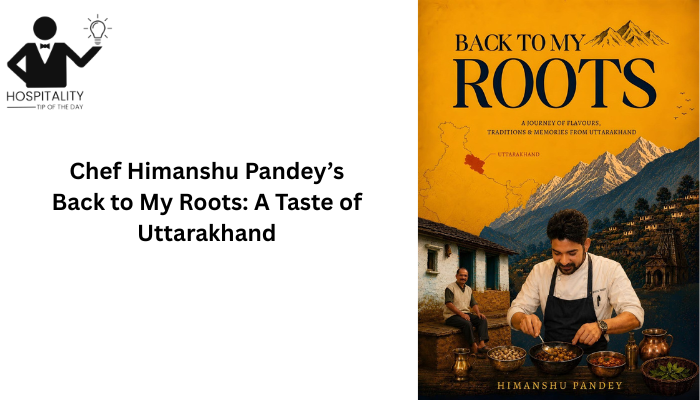
A culinary journey through the flavours, memories and traditions of Uttarakhand
There are cookbooks that teach you how to prepare a dish, and then there are books that remind you why food matters in the first place. Back to My Roots belongs firmly to the second category.
Written by Chef Himanshu Pandey, Back to My Roots is more than a collection of recipes. It is an intimate journey into the food, memories, people and traditions of Uttarakhand, particularly the Kumaon region that shaped his earliest understanding of cooking.
For Pandey, food began long before professional kitchens, restaurant menus and culinary techniques. It began at home — with the sound of vegetables hitting a hot iron kadhai, the aroma of mustard oil and garlic filling a mountain kitchen, seasonal greens being cooked with instinct, and simple meals prepared for family.
Those early experiences became the foundation of a culinary career that would eventually take him from Uttarakhand to professional kitchens across India, the Middle East and the United States.
Now, through Back to My Roots, Pandey is returning to those beginnings while ensuring that the flavours of the Himalayan region receive the recognition they deserve.
“More than a cookbook, this is my tribute to my homeland, my culture, and the people whose love lives in every recipe I create.”
The Roots Behind Chef Himanshu Pandey’s Culinary Journey
Before a chef learns technique, they often learn memory.
For Chef Himanshu Pandey, some of his most important culinary lessons came not from a professional culinary school or restaurant kitchen, but from his family home. His mother, Mrs. Hansi Devi Pandey, and his Nani introduced him to a style of cooking built on observation, instinct and generations of knowledge.
In traditional mountain kitchens, recipes were rarely measured with the precision expected in a professional kitchen. A cook knew when an ingredient was ready by its colour, aroma, texture and sound. Heat was judged by experience. Spices were balanced by instinct, and seasonal ingredients were used according to what was available.
There was precision in this cooking, even when there were no written recipes.
That understanding stayed with Pandey as his career progressed. Professional kitchens taught him discipline, consistency, systems and technical precision. His childhood kitchen had already taught him something equally important — how to listen to an ingredient.
From the Mountains to Professional Kitchens Around the World
With more than 18 years of culinary experience, Chef Himanshu Pandey has developed an international career spanning India, the Middle East and the United States.
His professional expertise covers Indian cuisine, fine dining, tandoor cooking, kebabs, biryanis, banquets and large-scale culinary operations. Today, he serves as Executive Sous Chef at Gymkhana Las Vegas, bringing together the discipline of a high-level professional kitchen with his continuing passion for Indian culinary heritage.
Yet his international career has not taken him further away from Uttarakhand. In many ways, it has brought him closer to it.
For Pandey, success is not about leaving his roots behind. It is about carrying them forward.
That idea lies at the heart of Back to My Roots. The book seeks to document traditional flavours that could easily disappear when recipes and culinary knowledge are passed from one generation to another through memory rather than written records.
At the same time, it introduces readers to a side of Uttarakhand that is often overshadowed by its mountains, forests and scenic landscapes — its food.
Discovering Uttarakhand Through Food
Uttarakhand cuisine has evolved around geography, seasonality and practicality. Mountain communities traditionally cooked with ingredients that were accessible and familiar, including grains, pulses, greens, herbs, potatoes and locally used spices.
The result is a cuisine that is earthy, nourishing and deeply connected to the landscape.
For Pandey, ingredients such as mandua, jhangora, bhang seeds and jakhiya represent much more than individual components of a recipe. They are connections to the land, family and cultural traditions of Uttarakhand.
His approach is not about transforming every traditional dish into fine dining. Instead, it begins by understanding the original dish — its texture, aroma, cooking vessel, technique and cultural significance — before considering how it can be presented to a contemporary audience.
That distinction matters.
Traditional food does not necessarily need to be reinvented to become relevant. Sometimes, it simply needs to be understood, documented and introduced to a wider audience.
A Cookbook Built Around Memory
At the emotional centre of Back to My Roots is family.
Pandey’s mother and Nani represent a generation of home cooks whose culinary knowledge often existed entirely in their hands, eyes and senses rather than on paper.
By documenting their recipes, Pandey is preserving more than cooking instructions. He is preserving stories.
A dish can carry the memory of a particular season, a childhood kitchen, a conversation around the dinner table or the unmistakable aroma of food being prepared by someone who knows exactly what home should taste like.
This is what gives Back to My Roots its personal character. The recipes are connected to people and places rather than existing simply as lists of ingredients and instructions.
“The journey forward became, in many ways, a journey back — back to the flavours that first taught me what food could mean.”
Taking Pahadi and Kumaoni Cuisine to the World
Indian cuisine is increasingly being appreciated through the diversity of its regional food cultures. Beyond internationally recognised dishes, diners are becoming curious about the lesser-known traditions that exist across India’s states, communities and landscapes.
Pandey believes Uttarakhand deserves that same attention.
Through Back to My Roots, his aim is to introduce the depth of Pahadi and Kumaoni cuisine to readers who may know Uttarakhand for its Himalayan scenery but have never experienced its distinctive food traditions.
The book therefore serves two purposes.
On a personal level, it is a chef’s journey back to the people, flavours and memories that shaped him. On a cultural level, it creates a record that can be shared with younger generations, chefs and food lovers around the world.
It is a reminder that regional cuisine is not simply about recipes. It is about identity, geography, history and the people who keep those traditions alive.
Featured Recipe: Pahadi Aloo Methi
Among the dishes that captures Pandey’s connection to his childhood is Pahadi Aloo Methi.
For him, the memory begins with a sound — potatoes hitting a hot iron kadhai.
In the traditional kitchens of Uttarakhand, the lohe ki kadhai was an everyday cooking vessel. As potatoes met hot mustard oil, the kitchen would fill with the aroma of cumin, garlic and spices.
Pahadi Aloo Methi was never reserved for elaborate celebrations. It was the kind of comforting food that belonged to ordinary days.
Fresh potatoes, seasonal methi and a handful of spices were enough.
Pandey remembers how his Nani and mother cooked the dish without relying on written instructions. They understood how hot the kadhai needed to be, when the potatoes had developed enough colour and when the methi needed to be added.
Their measurements were instinctive, but their results were remarkably consistent.
Today, when Pandey prepares the dish, those childhood memories remain part of the recipe.
Ingredients
- 500 g potatoes, cut into small cubes
- 250 g fresh methi, washed and chopped
- 2 tbsp mustard oil
- 1 tsp cumin
- ½ tsp jakhiya
- 3–4 garlic cloves
- 2–3 dried red chillies
- ½ tsp turmeric
- 1 tsp coriander powder
- ½ tsp red chilli powder
- ½ tsp roasted bhang seeds, crushed, optional
- 1–2 green chillies
- Salt, to taste
- 1 tsp lemon juice
How to Make Pahadi Aloo Methi
- Heat a well-seasoned lohe ki kadhai and add the mustard oil.
- Add cumin, jakhiya and dried red chillies.
- Add the garlic and sauté until fragrant.
- Add the potatoes, turmeric, coriander powder, chilli powder and salt.
- Cook uncovered for 12–15 minutes, turning occasionally so the potatoes brown evenly.
- Once the potatoes are nearly cooked, add the methi and continue cooking for another 8–10 minutes until tender and lightly roasted.
- Add the crushed bhang seeds and green chilli.
- Finish with lemon juice and a few drops of mustard oil.
How Pahadi Aloo Methi Is Traditionally Served
Pahadi Aloo Methi can be enjoyed with Mandua Roti, rice or as part of a traditional Pahadi thali.
The dish is intentionally simple. Its appeal comes from the combination of roasted potatoes, fragrant methi, mustard oil and the distinctive character of Uttarakhand’s traditional spices.
Chef Himanshu Pandey’s Signature Approach
For Pandey, Pahadi Aloo Methi should remain a dry preparation.
The potatoes should be small, well roasted and crisp around the edges, while the methi should coat the potatoes rather than turn the dish into a gravy-based preparation.
The lohe ki kadhai plays an important role. Its heat encourages the browning that gives the potatoes their characteristic roasted flavour and helps retain the rustic quality of a traditional Pahadi kitchen.
A few drops of mustard oil at the end bring its aroma back to the forefront. Lemon juice adds brightness and balances the earthy flavours.
There is no need for a complicated sauce or elaborate presentation.
The essence of the dish is simple: well-roasted potatoes, fresh methi, bold aromas and the unmistakable character of a Pahadi kitchen.
Why Back to My Roots Matters
Food can travel across borders remarkably quickly. Recipes can be adapted, modernised and reinterpreted for new audiences. But somewhere along the way, the stories behind those dishes can become forgotten.
Back to My Roots pushes against that loss of context.
It encourages readers to understand where a dish comes from before changing it, and to recognise the people and traditions behind the ingredients.
For Pandey, returning to his roots is not a rejection of modern cuisine. Instead, it provides a stronger foundation for it.
His international culinary experience has given him the techniques and professional discipline to work at a global level. His heritage gives that work its identity.
That combination of professional technique and personal memory is what makes the book distinctive.
It is not simply a chef documenting recipes. It is a chef documenting the journey that made him a chef.
Preserving a Culinary Legacy for the Next Generation
Perhaps the most meaningful part of Pandey’s project is what happens after the book is read.
A recipe written down can be cooked again. A story can be retold. An unfamiliar ingredient can be rediscovered. And a young cook can learn that the food prepared in their own family kitchen carries history and value.
That is the legacy Back to My Roots hopes to create — a living connection between generations.
The mountains of Uttarakhand shaped Pandey’s earliest relationship with food. His career carried those lessons into professional kitchens around the world. Through this book, those same flavours and memories now have an opportunity to travel even further.
“From the hills of Uttarakhand to the kitchens of the world, my journey has always carried the taste of home.”
About Chef Himanshu Pandey
Chef Himanshu Pandey is an Indian culinary professional with more than 18 years of experience across India, the Middle East and the United States.
His expertise includes Indian cuisine, regional heritage cooking, tandoor, kebabs, biryanis, fine dining and large-scale culinary operations. He is an American Culinary Federation-certified chef and a professional member of the Indian Culinary Forum, with recognition for his culinary work and contribution to Indian cuisine.
Based in Las Vegas, Pandey currently serves as Executive Sous Chef at Gymkhana Las Vegas.
His work continues to connect contemporary professional cooking with the regional traditions that shaped his childhood. Back to My Roots represents his personal contribution to preserving and sharing the flavours, memories and culinary heritage of Uttarakhand.
Back to My Roots — A Culinary Homecoming
At its heart, Back to My Roots is a story about coming home through food.
It is about a chef who travelled across countries and professional kitchens, yet continued to carry the flavours of Uttarakhand with him.
From mustard oil and jakhiya to mandua, bhang seeds and the humble iron kadhai, the book celebrates a culinary tradition that is deeply local yet capable of speaking to a global audience.
Chef Himanshu Pandey’s journey shows that sometimes, the road forward begins by looking back.
And sometimes, the most meaningful destination is home.
Book: Back to My Roots — A Journey of Flavours, Traditions & Memories from Uttarakhand
Author: Chef Himanshu Pandey
Buy: Amazon — Back to My Roots