
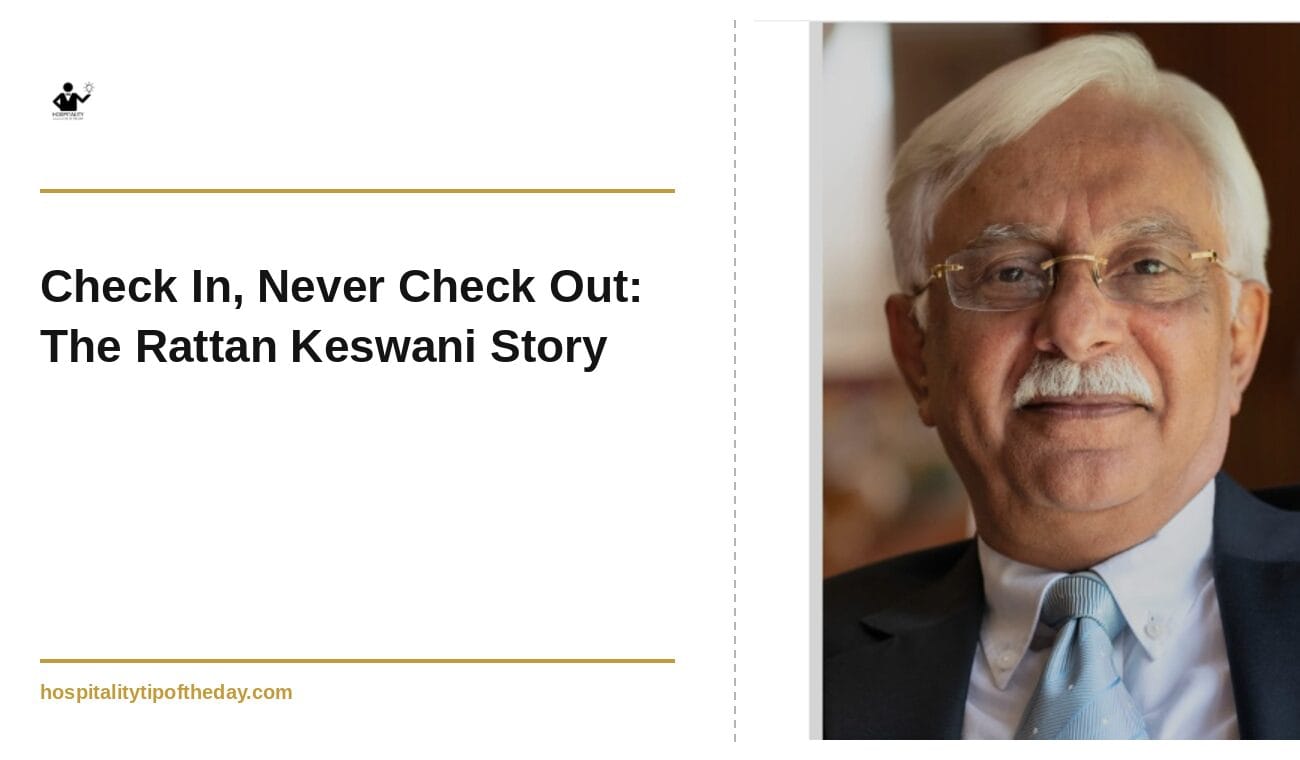
Check In, Never Check Out: The Rattan Keswani Story
Three of India’s most storied hotel companies. One career that keeps finding new rooms to walk into.
There’s a certain kind of hotelier who doesn’t just run properties — they build the instincts and standards an entire industry keeps running on long after they’ve moved to the next thing. Rattan Keswani belongs on that short list. Across a career spanning several decades, he has shaped three completely different chapters of Indian hospitality: mastering luxury hospitality at The Oberoi Group, running the country’s most prestigious business hotels under Trident, and leading the audacious scaling of an entirely new segment under Lemon Tree.
And somewhere in between all of that, he also became an author, a mentor to executives who’ve never set foot behind a front desk, and — by every account of the last few years — a man who still hasn’t quite figured out how to retire.
The Oberoi Years
Keswani’s career began at the Oberoi School of Hotel Management, the training ground that has produced some of Indian hospitality’s most disciplined operators. It wasn’t just a finishing school for service — it installed a certain obsessiveness about detail that would define everything he did for years to come, as he rose through general manager roles across some of the group’s most prestigious properties in India, the Middle East, and Sri Lanka, along the way collaborating with international names like Sheraton, Intercontinental, Holiday Inn, and Hilton.
Running an Empire of Icons
In time, Keswani was named Executive Vice President of Oberoi Hotels, overseeing The Oberoi Mumbai alongside Trident Nariman Point and Trident Bandra Kurla — three of the city’s most important addresses under one charge.
Later came the role that would define his standing in the industry: President of Trident Hotels, responsible for more than a dozen properties nationwide — from gleaming metro business towers to heritage landmarks like Maidens Hotel in Delhi and Clarkes Hotel in Shimla. Running a colonial-era heritage property and a modern business hotel under the same portfolio takes two entirely different instincts — one calls for reverence, the other for relentless reinvention. Few hoteliers are trusted with both at once. Keswani was — before making the boldest call of his career.
The Lemon Tree Leap
After more than three decades inside the Oberoi ecosystem, Keswani did something senior luxury hoteliers rarely do: he walked away from ultra-luxury entirely. He joined Lemon Tree Hotels as Deputy Managing Director and became Co-Promoter and Director of Carnation Hotels, the group’s arm for the upper-midscale segment.
It was a different education altogether. Oberoi had taught him quality and luxury without compromise. Lemon Tree taught him precision at scale — and introduced him to a business built partly around employing people with disabilities, a value woven into the brand’s identity from the ground up. Over the following decade, he helped grow Lemon Tree into one of India’s largest hotel chains in its segment, proving that instincts sharpened in five-star luxury could scale into a completely different price point and business model.
He eventually stepped away from the corporate role — after roughly four decades since he’d first checked in.
The Chapter That Wouldn’t Check Out
Most careers end at retirement. Keswani’s simply changed shape. He turned consultant, coach, and mentor — not just to hoteliers, but to senior executives across industries trying to understand how to build teams that outlast any one leader.
He went on to write his book, Check-In, Never Check Out — and gave it not one launch, but three, each pulling in a different corner of the industry. The first was held at the Trident in Mumbai, with Rajiv Kaul and Amit Kaul among those who turned up for it. The second took place at The Oberoi, with Visheshwar Raj Singh and Abhishek Panshikar in attendance. The third came together as a fireside chat with the legendary Vir Sanghvi — a fitting way to close out a book built on a lifetime of industry conversations. Fittingly, the proceeds from the book go to Muskaan PAEPID, an NGO that trains and places people with disabilities — the same cause Lemon Tree had quietly built into its own business model years earlier. The book has since been praised not just by hospitality veterans, but by authors, journalists, and CEOs well outside the industry.
He hasn’t slowed down since. He now holds an advisory board seat at Manav Rachna University, serves as Strategic Advisor to ALIGN Hotels & Resorts, and hosts his own podcast — turning the tables to interview the industry’s current leaders after decades of being the one asked the questions.
Why This Story Actually Matters
It would be easy to read Keswani’s career as an impressive résumé — three legendary companies, a book, a podcast, advisory seats. But the real lesson is rarer than any single line on it. Few careers in this industry touch every segment the way his has — luxury to upper-upscale, midscale to economy, even fractional ownership — and fewer still let someone speak with equal authority about heritage properties and modern towers, about running a brand and honestly writing about what running one actually costs a person.
As he’s put it himself, in a line that could double as a mission statement for anyone starting out in this industry: “Anybody can become anybody they want to.” Coming from someone who started as a management trainee and went on to help shape how two of India’s biggest hotel companies think about their guests, that’s not a platitude. It’s a résumé.
Rattan Keswani still hasn’t checked out. Judging by the last few years, he doesn’t plan to anytime soon.
Suggested tags: #Hospitality #HotelIndustry #IndianHospitality #Leadership #Mentorship